mirror of
https://github.com/alexhopeoconnor/firmware.git
synced 2026-10-16 00:21:35 +10:00
 Clive BlackledgeandClaude Opus 5
579d26e1b2
Clive BlackledgeandClaude Opus 5
579d26e1b2
Clients send `add_contact` before every text-message DM, because a phone
often holds a larger contact database (with public keys) than the radio
can keep. That makes `addFromContact()` the highest-volume key-write path
on the device - and it had no protection against key erasure.

Its only key guard covered the manually-verified case: if the local entry
was marked manually verified and the incoming contact was not, a key
mismatch aborted the update. Every ordinary entry fell straight through to
`CopyUserToNodeInfoLite()`, which assigns `public_key` unconditionally. So
a SharedContact with `has_user` set and an empty `public_key` overwrote a
peer's stored, XEdDSA-proven key with zeros - and `addFromContact()` calls
`saveNodeDatabaseToDisk()`, so the erasure survived a reboot. Subsequent
DMs to that peer then failed with PKI_SEND_FAIL_PUBLIC_KEY, with no way to
recover until the peer's NodeInfo was re-exchanged.

`public_key` is a singular (non-optional) bytes field, so "absent" and
"empty" both decode to size 0; a client that simply has no key for a
contact is indistinguishable on the wire from one asking to clear it.

The fix is deliberately narrow: keep the stored key when the entry already
holds a full 32-byte key and the incoming contact does not. A well-formed
32-byte contact key still updates the entry exactly as before.

Deliberately NOT changed here:
- `updateUser()`'s first-key-wins pin is not applied to this path. Clients
  legitimately use add_contact to supply keys the radio never had and to
  update them (QR-code contact sharing); a blanket pin would break that
  documented flow. Only erasure is refused.
- `CopyUserToNodeInfoLite()` itself is untouched - it has many other
  callers (self-record refresh, updateUser, warm-tier rehydration), so the
  guard lives at this call site.
- The manually-verified branch is unchanged.
- Node-number validation (reserved/broadcast/self) on this path remains
  open and is tracked separately.

Co-authored-by: Claude Opus 5 <noreply@anthropic.com>

Meshtastic Firmware




Overview
This repository contains the official device firmware for Meshtastic, an open-source LoRa mesh networking project designed for long-range, low-power communication without relying on internet or cellular infrastructure. The firmware supports various hardware platforms, including ESP32, nRF52, RP2040/RP2350, and Linux-based devices.
Meshtastic enables text messaging, location sharing, and telemetry over a decentralized mesh network, making it ideal for outdoor adventures, emergency preparedness, and remote operations.
Get Started
- 🔧 Building Instructions - Learn how to compile the firmware from source.
- ⚡ Flashing Instructions - Install or update the firmware on your device.
Join our community and help improve Meshtastic! 🚀
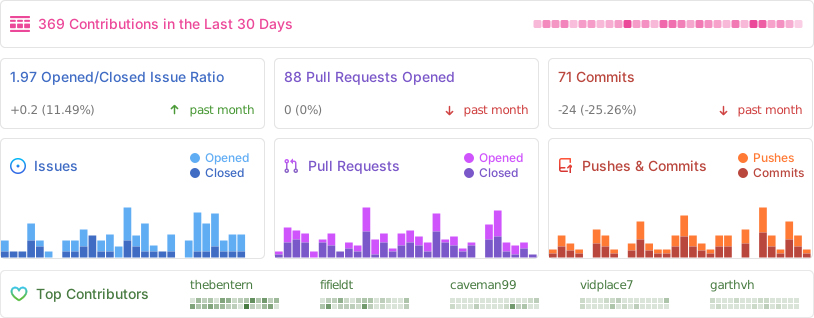
Stats